
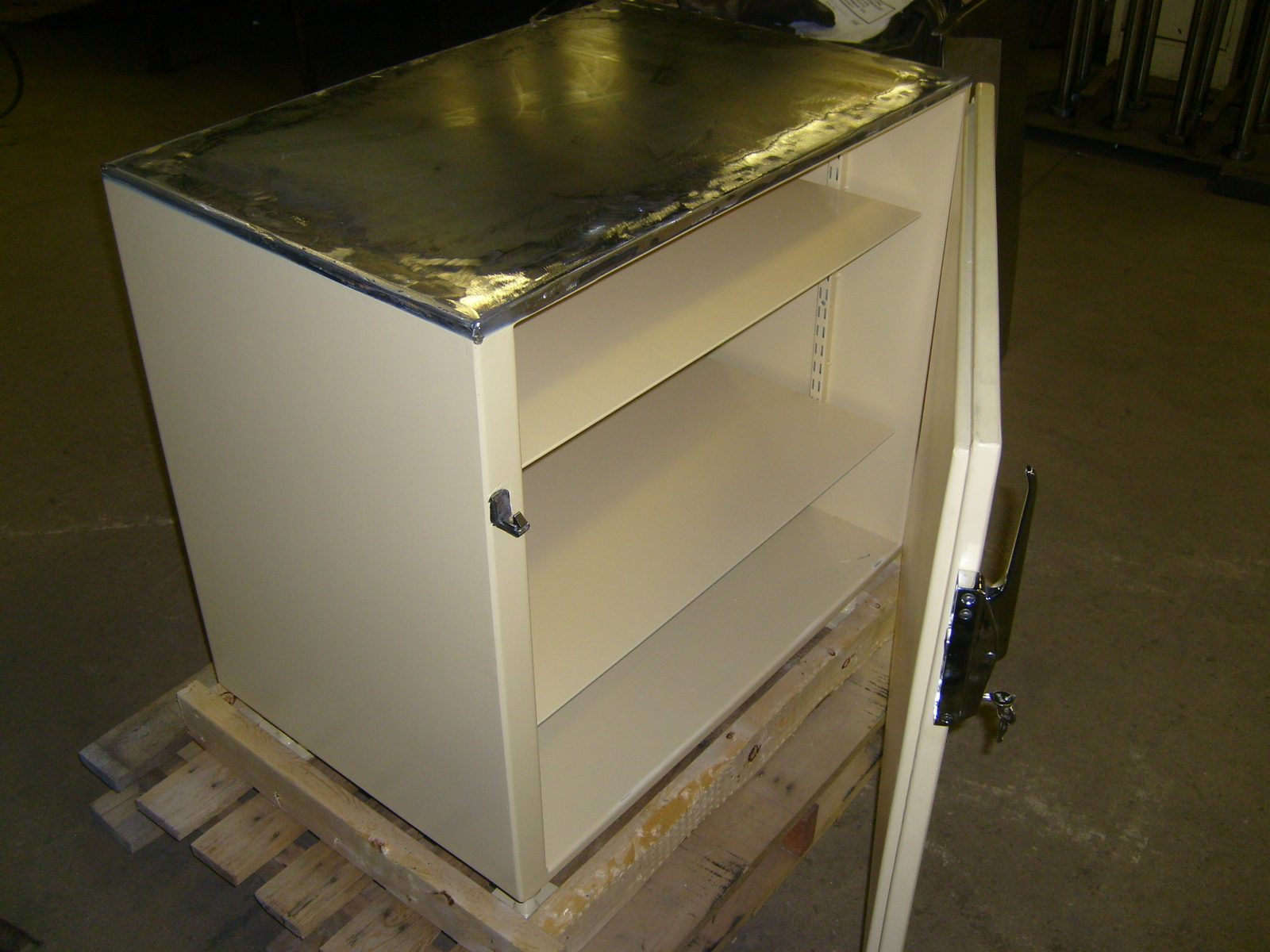
The last weld is not the end of the job. A bare steel frame starts to flash rust the day it is built, a stainless cabinet with heat tint on the welds will spot within a season, and an aluminum part that gets no finish at all is often the right call. Finishing is where a weldment becomes something a customer can install, clean and look at for twenty years. In this shop it is planned from the first drawing, not added at the end.
Carbon Steel, Stainless and Aluminum Want Different Things
Carbon steel rusts, so it gets coated. An indoor machine base can live on shop primer and a coat of enamel. A frame bolted outside in Burlington, with road salt and freeze and thaw, wants a real paint system, powder coat or hot dip galvanizing.
Stainless protects itself with a thin chromium oxide layer, and finishing puts that layer back where welding and grinding damaged it. Stainless is rarely painted. It is cleaned, pickled, passivated and either brushed or polished, as covered in the stainless fabrication post.
Aluminum forms its own oxide and a lot of aluminum work ships as welded. When it needs colour or wear resistance it is powder coated, with a chemical pretreatment instead of a blast, because a steel-grade blast profile tears up soft aluminum.
Surface Prep Decides Whether the Coating Lasts
Every coating failure we have been asked to look at traced back to prep, not paint. Hot rolled steel arrives with a layer of blue-black mill scale that looks solid and is not. Paint over mill scale sticks to the scale, the scale lets go of the steel, and the paint comes off in sheets. The scale has to come off, by sandblasting on anything that matters, or by grinding and a chemical clean on small parts.
Welds get the same treatment. Spatter is knocked off, sharp weld edges are ground to a radius so the coating does not thin out over them, and visible welds are blended as far as the drawing calls for. Sandblasting leaves a profile, a controlled roughness the primer keys into, and for powder coat or a heavy paint system the coating manufacturer specifies it. We arrange blasting through a partner shop and coat the same day, because blasted steel starts rusting again within hours.
Shop Primer, Finish Paint and Powder Coat
Priming and painting are done in-house. Shop primer is a thin red oxide or grey coat that keeps a part from rusting between here and the site, and most industrial weldments leave wearing it. It is not a finish. If the part will be painted the house colour on site, primer is all it needs, and the quote says so.
A finish system is primer plus one or two topcoats chosen for the service: alkyd enamel indoors, epoxy primer with a urethane topcoat outdoors, around chemicals or in washdown. Parts are painted as complete weldments so the welds are coated too.
Powder coat is a dry polymer sprayed on electrostatically and baked until it flows into a hard, even skin. It is tougher than wet paint, does not sag on vertical faces, and is the right finish for railings, gates, cabinets, enclosures, guards and equipment frames. The limits are the oven and the heat. The part has to fit the coater's oven, so long rails and big frames are built in bolt-together sections, decided at the design stage. Everything on the part sees roughly 200 degrees C, so rubber, plastic and bearings come off first, and closed tube gets vented. Powder does not hide a rough weld either. It is thin and follows the surface, so a weld that needs to disappear is ground before the part leaves.
Pickling and Passivation So Stainless Stays Stainless
Welding stainless leaves a dark heat tint beside the bead. That tint is chromium depleted oxide, and under it the steel has less corrosion resistance than the parent metal. That is exactly where rust shows up. Iron picked up from a grinding disc or a dirty table makes it worse, so stainless here is worked with dedicated tools and kept off carbon steel surfaces.
After welding, the heat tint is removed by pickling, with a paste on the weld zones or by immersion for smaller parts. Passivation follows, a chemical bath that strips free iron and lets a full strength oxide layer form across the whole surface. Then the mechanical finish: a uniform grain blended through the welds for food equipment and architectural work, or a glass bead blast for a matte surface that hides fingerprints.
Hot Dip Galvanizing for Exterior Steel
For posts, platforms, exterior frames and support stands that live outdoors with no maintenance, hot dip galvanizing is hard to beat. The finished weldment is dipped in molten zinc and comes out with a coating bonded to the steel that protects it even where it gets scratched. We do not have a zinc kettle, so galvanizing goes to a partner and is managed from here.
Galvanizing has rules that must be designed in. Every closed section needs vent and drain holes so zinc can fill it and air can get out, and a sealed tube in a zinc bath is dangerous. This is routine when we know the part is going for galvanizing before the first cut, and expensive when we find out after it is welded.
Planning the Finish Into the Build, and What to Put on the Drawing
Finishing where you fabricate means nobody handles the part twice. The finish is on the quote, and the shop sequence is built around it. Vent holes get laid out on the cutting table. Welds that will be powder coated get ground while they are still easy to reach. A railing that has to go for powder is formed, welded and fitted in sections that fit the oven. Customers bring work to the shop at 3485 Mainway in Burlington, or ship it, and it leaves finished. Priming and painting happen in the building, and blasting, powder and galvanizing run through our finishing partners and get checked when they come back.
On the drawing, say what finish you want and where it goes. For paint, name the system or describe the environment and we will pick one. For powder, give the colour code and gloss. For stainless, give the surface finish number and say whether welds are blended. For galvanizing, say so, and we will add the vents. Mark any surface that must stay bare. Customers bring this work in from Hamilton, Oakville, Milton and Mississauga as well as Burlington, and the finish is quoted line by line with the welding and fabrication.