
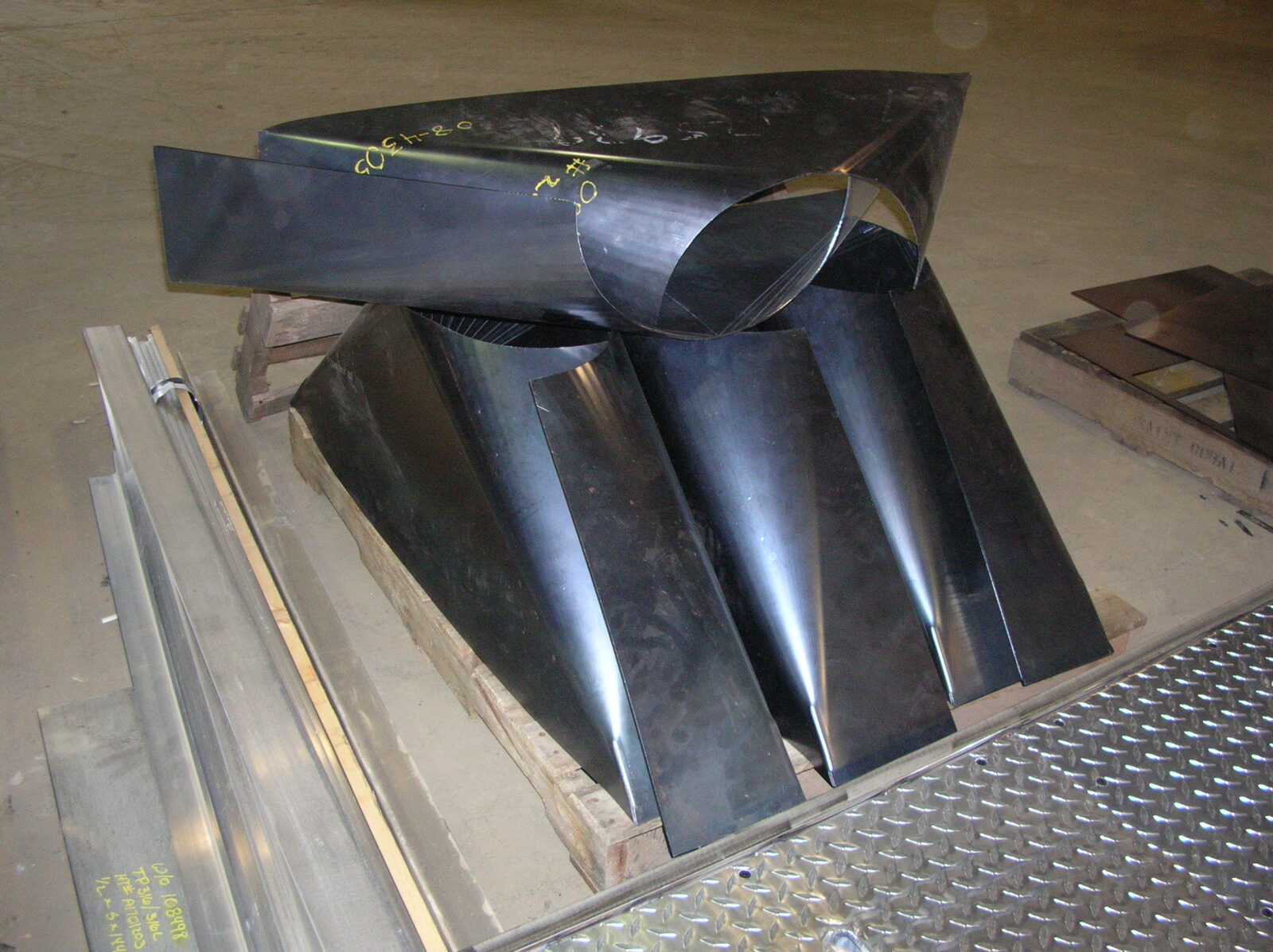
Most of the metal that comes into this shop arrives flat, and a good share of it leaves with a bend in it. Brackets, gussets, channels, guards, machine covers, hopper transitions, duct fittings. The parts in the photo above are a set of transitions bumped on our brake press: square to round, laid out flat, bent in a series of small hits and then seam welded. Nobody stocks a part like that. Somebody draws it, and a shop with a press brake makes it.
What the Brake Press Does
A press brake clamps a flat sheet between a punch and a die and pushes a straight bend into it. String a few bends together and you have a channel, a box, a Z bracket or an enclosure. Take lots of shallow bends close together and a flat sheet turns into a curve, which is the bumping in the photo and how a transition or a large radius part gets formed when it is too awkward for the rollers.
Brackets, gussets and mounts. The everyday work. Cut on the plasma, laser or waterjet, bent to the drawing, holes where the holes go.
Channels, angles and Z sections. Formed from plate when the size you need is not a stock shape, or when it has to be stainless or aluminum.
Guards, covers and enclosures. Machine guarding, electrical enclosures, chute covers and cabinets, formed and then welded into a rigid box.
Transitions and fittings. Square to round, offsets and reducers for hoppers, dust collection and duct runs, bumped or bent then seam welded.
Brake or Roller?
The brake press makes straight bends and, with bumping, gentle curves. Anything that has to be truly round, a cylinder, a ring, a cone, goes to the rollers instead. Plenty of parts use both: a rolled shell with a brake-formed flange, a bumped transition with a folded hem. Having the shears, the cutting tables, the brake and the rollers in one building means the part is designed around what makes it well, not around whichever machine the shop happens to own.
What Makes a Part Bend Cleanly
Three things decide whether a formed part comes out right. The inside radius has to suit the material, because too tight a bend in thick plate or in aluminum will crack. There has to be enough flat leg on each side of the bend for the tooling to grip. And the flat pattern has to allow for the metal stretching around the bend, which is why we do our own layout rather than bending to a nominal dimension and hoping. Stainless springs back more than mild steel, so it gets over-bent to land on the angle. None of this is exotic, it is just the difference between a part that fits and one that gets remade.
Formed, Welded and Finished Under One Roof
A bent part is rarely the finished part. It gets fitted to something, welded, maybe machined for a bolt pattern, then primed or painted. Doing all of it here means the same people who formed the piece weld it in the right sequence so it stays square, and the fabrication, machining and finishing sides are a walk across the floor rather than a truck across town. One shop, one quote, one delivery.
Getting a Forming Quote
Send a drawing or a decent sketch with the material, the thickness, the bend dimensions and how many you need. A photo of the old part works too. Bring it to 3485 Mainway in Burlington or send it through the contact form. Shops across Hamilton, Oakville, Milton and Mississauga send forming work here for the same reason they send rolling: it comes back bent, welded, finished and right.