
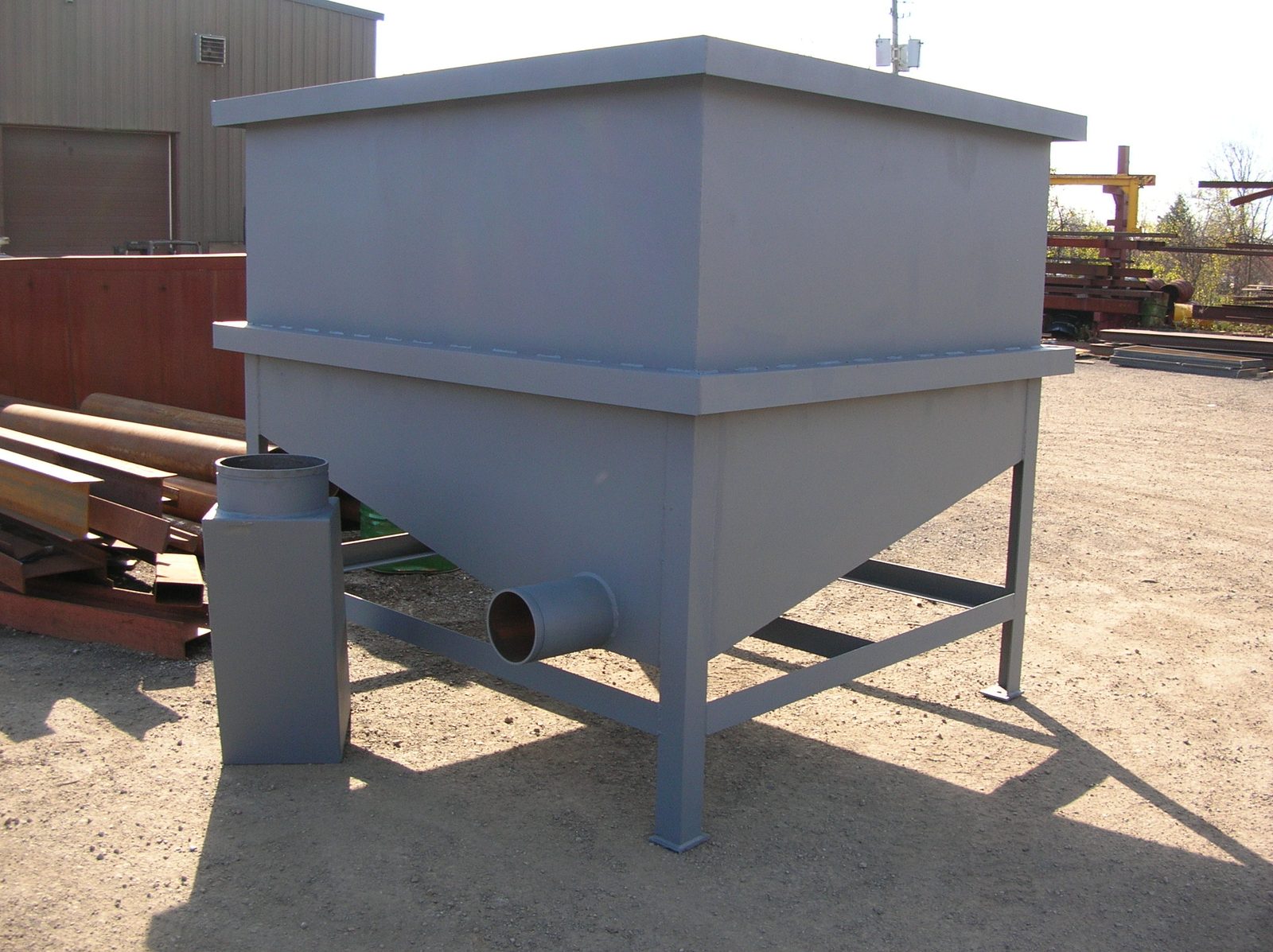
The hopper in the photo started as flat plate. Sides cut and brake formed, a cone bottom laid out and bent, a discharge spout rolled, a stand built from structural, all of it fitted and welded and primed before it went on the truck. Nobody sells that off a shelf. A plant needs one to suit the machine it feeds, the headroom it has to fit under and the material it has to hold, so somebody draws it and a shop builds it.
What Counts as Heavy Plate Work
The common thread is thick material formed and welded into something that holds shape under load.
Hoppers, bins and cone bottoms. Feed hoppers, surge bins, collection hoppers, with the discharge and the support stand built to suit the equipment underneath.
Tanks and vessels. Atmospheric tanks, sumps, quench tanks and jacketed vessels in carbon or stainless.
Chutes and transitions. Square to round, offsets and reducers, often lined or built in wear plate where the material is abrasive.
Machine shells and heavy weldments. Bases, housings, incinerator shells, frames stiffened with plate and structural so they stay flat under load.
Fit Up Is the Whole Job
People assume the welding is the hard part of a big weldment. It is not. The hard part is fit up. Get the plates cut to the right flat pattern, get the seams tight, get the thing square and plumb on the floor before an arc is struck, and the welding is straightforward. Get the fit up wrong and no amount of good welding saves it. Doors bind, flanges do not land on their bolt pattern, a cone sits off centre on its barrel and the whole piece has to be cut apart and reset. That is why the layout and the cutting happen here rather than arriving as a pile of parts from somewhere else.
Keeping It Square While It Welds
Weld metal shrinks as it cools, and on a piece the size of a hopper that pull adds up fast. A long seam run straight down one side will bow the whole panel. So the sequence matters: stitch and balance, alternate sides, back step the long seams, tack the stiffeners before the main welds go in and leave the piece braced until it has cooled. Thin stainless and aluminum move more than carbon plate and get treated accordingly. It is unglamorous and it is the difference between a finished piece that sits flat and one the customer has to shim.
Formed, Rolled and Welded in One Building
A hopper is not one process. The sides get bent on the brake press, the spout and any barrel sections get rolled, the flanges and mounting pads get machined, and then it all gets fitted and welded. Having the cutting tables, the brake, the rollers, the machine shop and the finishing bay in one building means the same crew carries the piece from plate to primer, and nothing sits on a truck between steps.
Getting a Quote
Send a drawing if you have one. If you do not, a sketch with the capacity or the overall dimensions, the material, the plate thickness, what it has to sit on and what it has to connect to will get you a real number. Photos of the unit you are replacing help more than anything. Bring it to 3485 Mainway in Burlington or send it through the contact form. Plants across Hamilton, Oakville, Milton and Mississauga have their plate work built here.