
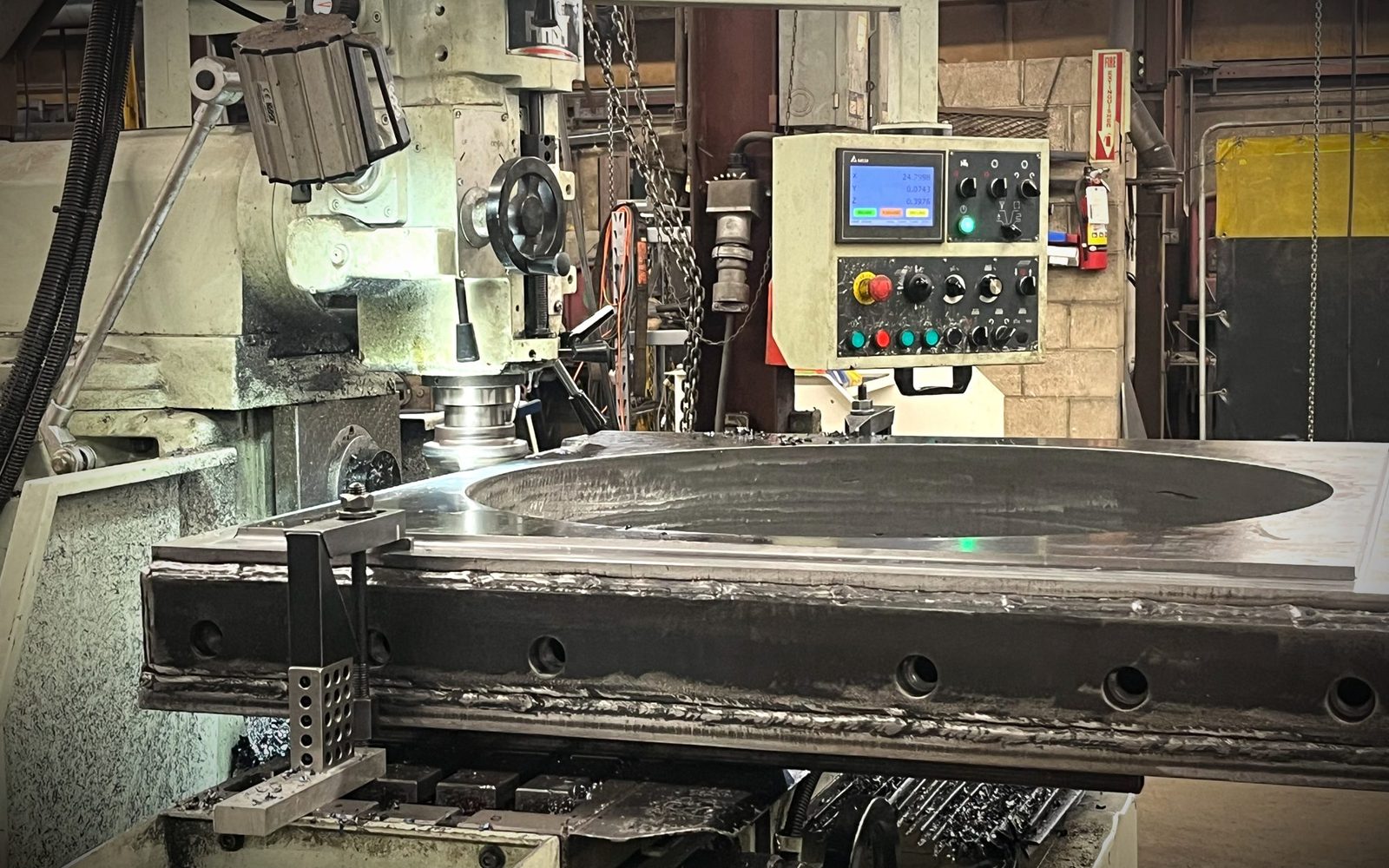
A welded assembly comes off the table square and strong, and it still will not fit. The bore is a few thou undersized, the mounting face has a hump where the weld pulled it, the shaft is not quite concentric with the housing it sits in. None of that is a welding mistake. Welding puts heat into steel and steel moves when it is heated. The fix is the machine shop, and the reason a fabrication shop keeps one is so the part does not have to go across town on a truck to get there.
Why Machining Comes After Welding
Every weld shrinks as it cools and pulls the metal around it. On a bracket that does not matter. On a bearing housing, a flange that has to seal, a machine base that has to sit flat on a pad, it is the difference between a part that bolts up and a part that gets shimmed and cursed at for the next ten years. So the sequence in this shop is: cut, form, weld, let it settle, then machine the surfaces that matter. The mill takes the mounting face flat. The lathe bores the housing round and on centre. The weldment carries the strength, the machining carries the fit.
Doing it the other way around, machining first and welding after, works only when the welds are far enough from the finished surfaces that the heat cannot reach them. Sometimes that is possible. More often a part that was machined first comes back needing to be machined again.
What Gets Machined Here
Faces and pads. Mounting surfaces on machine frames, bases and stands, milled flat and parallel so the equipment sits where it should without shims.
Bores and housings. Bearing seats, bushing bores, pivot points and pin holes, bored on the mill or the lathe to the fit the bearing or the pin actually needs, not the fit the plasma cutter left.
Flanges and connections. Rolled rings and cylinders get their flange faces turned true so a gasket seals. Pipe and tank connections get faced after welding for the same reason.
Shafts, pins and bushings. Turned from bar in steel, stainless or tool steel, with the keyway, the threads or the snap ring groove cut in the same setup.
Replacement parts. The worn gear hub, the cracked adapter, the part the manufacturer wants three weeks and a wire transfer for. We measure what is left, work out what it was, and make a new one. A customer with a failed machine part who was quoted three weeks from the manufacturer was back running in under 24 hours from this shop, and that is not unusual.
The Equipment and What It Holds
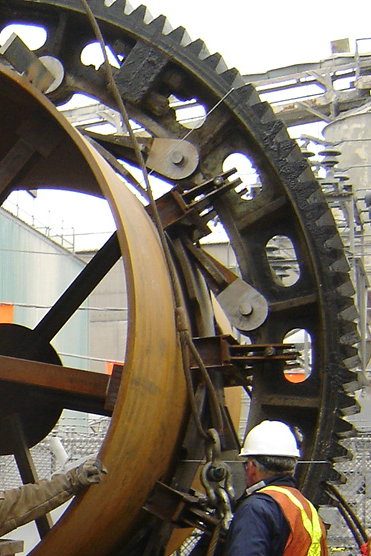
The shop runs conventional milling and lathe equipment, and holds +/- .001 on both. The mill has a working envelope of 32.9 in in X, 14.5 in in Y and 17 in in Z. The lathe takes up to 11 in diameter and 46 in between centres. Materials are steel, stainless, aluminum and tool steels. That covers the great majority of what a fabrication job needs machined, and when a part is outside that envelope we say so up front instead of making it fit badly. The full capability table is on the custom machining page.
One Shop, One Part, No Truck
The practical reason to have fabrication and machining under the same roof is the part never leaves. A hopper flange gets formed, welded, faced on the mill and sent to finishing without a shipping label. There is no second shop quoting a setup charge, no one arguing about whose tolerance the drawing meant, and nothing waiting on a pallet for a week between steps. When a machined surface and a welded joint have to agree with each other, it helps when the same people did both.
What to Send for a Machining Quote
A drawing is best, with the tolerances marked on the surfaces that matter and left loose on the ones that do not. Tight tolerances everywhere cost money and buy nothing. If there is no drawing, bring the part or the mating part, or send photos with the critical dimensions written on them. Tell us the material, what the part does and how fast you need it. We quote material, machine time and any welding or fabrication line by line, and customers bring this kind of work from Hamilton, Oakville, Milton and Mississauga as well as Burlington.